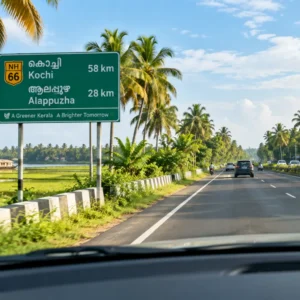

Alleppey’s canals narrow to a few metres in stretches around Chennamkary, and that one detail shapes almost every decision in houseboat photography. You are shooting from a deck that drifts, through light bouncing off open water, at scenes that slide past in under ten seconds. Most visitors go home with ninety versions of the same palm tree.
Reading the Route Before You Lift the Camera
Houseboat photography in Alleppey backwaters rewards people who know where the boat is headed. Kerala Tourism describes the district’s waterways as a network running over 900 kilometres of canals, rivers and lagoons. A cruise starting near Pallathuruthy usually threads through tight Kuttanad canals first, then opens into Vembanad Lake.
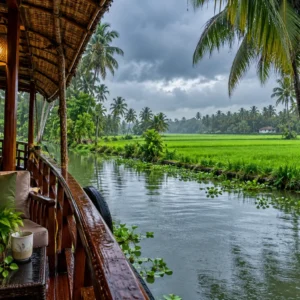
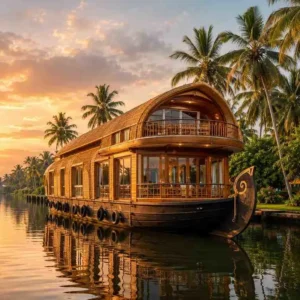
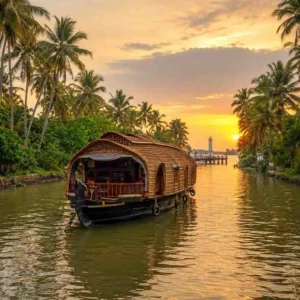
Those two settings ask for different framing. Canals compress everything, so you get coir boats, church spires, laundry strung between coconut palms, and kids waving from washing steps. The open lake hands you scale instead, with other kettuvallam boats working as foreground weights against a wide sky. Ask the crew for the day’s route before you unpack a single lens. Five minutes of conversation saves an hour of guessing.
Deck layout matters too. The open-deck and private-balcony arrangements vary between the luxury, premium and deluxe houseboats listed by Kerala Boat House, and a wider bow deck simply gives you more angles to move through.
The Best Time of Day for Houseboat Photography
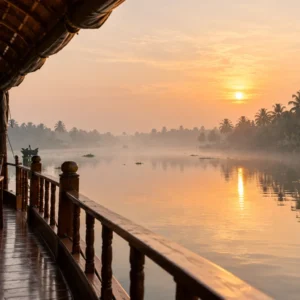
Two short windows do the heavy lifting. Sunrise is the first, and it is the one people miss, because houseboats moor overnight and stay anchored until morning. That stillness is a gift. Mist sits low over the water around first light, the surface goes almost glassy, and reflections hold shape long enough to compose properly.
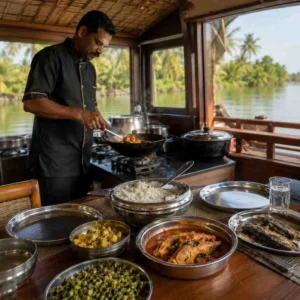
The second window arrives roughly forty minutes before sunset, when the water turns amber and the coconut fringe reads as a clean silhouette. Midday light on the backwaters is flat and hard. Use that stretch for interiors and food instead, since onboard meals and the AC bedrooms photograph well in diffused window light.
That Work From a Moving Deck
Standing at chest height and pointing outward produces the postcard nobody looks at twice. Drop lower. Sitting on the deck floor puts the camera close to the waterline, which exaggerates the width of the canal and pulls reflections into the bottom third of the frame.
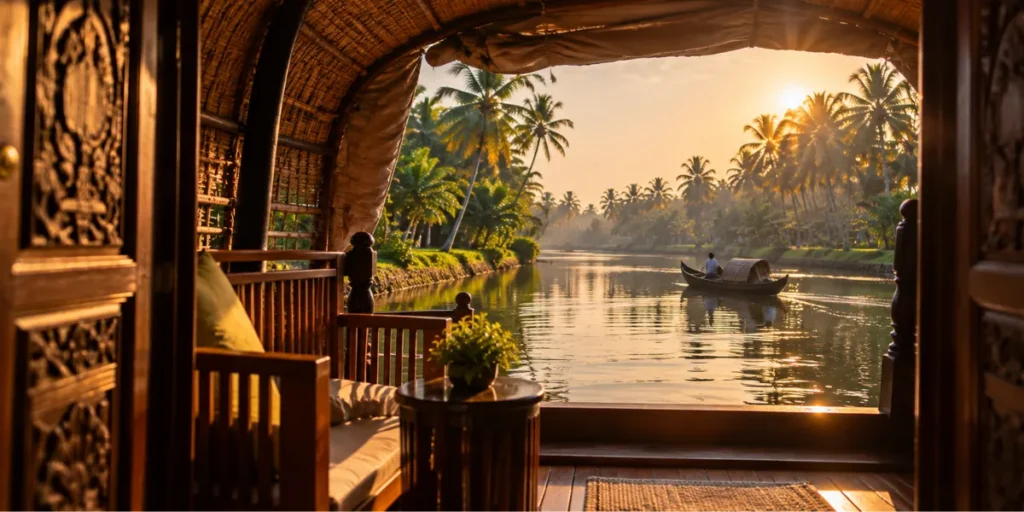
Shoot through the boat, not just past it. The carved wooden doorway, the coir-and-bamboo roof curve, and a coil of rope on the rail: each one frames the landscape and tells the viewer where you were standing. Another approach is to shoot along the hull towards the bow so the boat’s own line leads the eye into the distance.
Wake lines are underrated. When a country boat crosses behind you, wait three seconds for the ripple to reach your frame, then release.
Birds, Paddy Fields and Photographing Village Life
Vembanad is not only scenery. The Vembanad-Kol wetland was designated a Ramsar site of international importance in 2002, and the listing records over 90 resident bird species alongside roughly 50 migratory ones. Cormorants, kingfishers and egrets show up along canal edges through the morning.
Village life needs a lighter touch. People live along these banks, and a lens pushed into a doorway is intrusive anywhere in the world. Ask, smile, and accept a no. The photographs you get after a short exchange are better than the ones you steal, every single time. If your itinerary runs beyond the water, the notes on things to see around Alleppey besides the backwaters are a reasonable starting point for land-based shooting.
Settings, Gear and Staying Safe on Deck
Keep the shutter speed at 1/500 or faster while the boat is under way, because the deck vibrates even at cruising pace. A polarising filter cuts glare off the water and deepens the green of the paddy. Humidity here is high year round, so let your camera acclimatise before opening the bag, and keep a microfibre cloth in your pocket for lens fog.
Safety is plain common sense. Railings on a moving vessel are not tripods, wet deck boards are slippery, and no shot is worth leaning out over the water. Drone operation over the backwaters is governed by Indian civil aviation rules, so check current regulations and confirm with your operator rather than assuming clearance.
Final Thoughts
Good backwater images come from timing and position, not from expensive kit. Decide your two light windows, learn the route, and spend the rest of the cruise watching instead of shooting. If you are planning a stay and want to know how the deck and cabin layout affects your shooting positions, contact your houseboat operator directly.
So which will you set the alarm for: the mist at sunrise or the amber hour before the boat moors?
FAQ
Sunrise wins, and it is not close. The boat is moored, the water is still, and mist sits over the canal until about seven. Evening runs a close second, roughly forty minutes before the sun drops. Skip midday for landscapes and shoot interiors instead.
Phones handle this fine. Backwater scenes are wide and evenly lit during golden hour, which is exactly where phone sensors perform. Lock exposure by tapping the brightest part of the sky, keep the lens wiped clean, and avoid digital zoom. Distance shots of birds are where a real camera pulls ahead.
Ask first. Families live along those banks, and the canal is basically their front yard. A wave, a gesture at the camera, a nod back: that is usually the whole exchange. Some will decline, which is completely fair. Photographing children without a parent agreeing is not on.
Both, for different reasons. Narrow Kuttanad canals give you detail and human activity within arm’s reach. Vembanad Lake gives you scale, sky and other boats as subjects. A route that covers both is what you want, so ask the crew how the day is planned.
Drone use in India falls under civil aviation regulations, and rules change. Check the current requirements yourself, then confirm with your operator before travelling. Some stretches and some moorings are restricted. Assuming it is fine and finding out otherwise mid-cruise is a poor plan.